Monday, September 2, 2013

Devilman: A Theodicy


If you think comic books or cartoons are just for children, then please, for God’s sake, don’t let your kid ever watch or read Devilman. Devilman is a work strictly for adults, and for thinking adults. If you are narrow minded, you’re probably going to walk away thinking it’s satanic or some nonsense. So, what exactly is Devilman? Devilman is a manga (basically a Japanese comic book) written by Go Nagai all the way back in 1972. There are also two OVAs that were produced in the 80’s that animate chunks of the original manga.

Devilman centers on the young Akira Fudo, who becomes aware of the existence of demons. Due to his pure heart, he not only survives a possession, but takes control of the most powerful demon in existence, Amon, and thus becomes Devilman. Devilman fights to protect mankind and the girl he loves, Miki. Sadly, after waging war on the demonic hordes, Miki is actually murdered by fearful humans in retaliation for her relationship with Akira. Seeing his beloved’s head on a pike, Devilman becomes enraged and kills the mob. With no one left to protect, he begins his final battle with Satan, who while dormant, was his childhood friend, Ryo.

After the Earth is destroyed in their battle, Satan is victorious and lays next to Akira as he dies. He tells Akira that he loves him. He details the origins of demons, explaining that God created them, but hated what he had made. Satan, then an angel, believed this to be unjust of God and sided with the demons. However, Satan realizes that he was just as wrong as God for trying to destroy humans.

Of course, I just outlined the whole plot, but it serves my next point. There are very few Japanese works that rival Devilman’s drama. Devilman is about the tragedy of life. Not only is this great storytelling, but it’s very interesting from a theodicy point of view. Of course, Christians believe God to be good, and that Satan is evil, but why do we believe that? Have we forgotten Epicurus’ problem of evil, "Is God willing to prevent evil, but not able? Then he is not omnipotent. Is he able, but not willing? Then he is malevolent. Is he both able and willing? Then whence cometh evil? Is he neither able nor willing? Then why call him God?" Basically, is God a villain or a fool?

Devilman answers in the former, that God is evil. What is forgotten, I think, is that there is another option. That God loves us, and in His love, He has given us free will. Free will is the ability to choose good or evil. Or rather, to obey God or not to obey Him. You see, God knows our tears, but He isn’t deaf to our pleas. If everything was perfect, and we never had a choice, yes there would be no physical pain, but there wouldn’t be any true love in the universe. You have to have choice to have love; it can’t be forced. So, when humanity chose to defy God in Genesis, God made a choice, too (If God doesn’t have free will as well then He’s just a force of nature, not a personal being). God chose to love us, and love us unconditionally. He could and should have left us to wallow in our own filth and misery, but for no other reason than He loves us, He decided to offer redemption through His son, Jesus.

The cross is the perfect answer to the problem of evil. It’s poetry in motion. It’s divine love. So, while I really like Devilman as art, I do believe the philosophical content it brings up is flawed. Still, it’s one hell of a story.

Sunday, September 1, 2013

Syria


Well, I’ve tried to avoid talking about politics for a while now… but since the powder keg of the Middle East is about to be ignited by a certain buffoonish president, I thought I should put my thoughts down before it all blows up. I’m honestly surprised at Obama. I really am. I mean, Obama has been a fairly mediocre president, but he’s never screwed up this badly before. I’m going to sum this Syrian mess up in a single sentence: You can’t be against the Iraq War and be for involvement in the Syrian Civil War. That’s the crux of it.

Seriously folks, are we forgetting about the Iraq War? Are we lemmings gleefully running over a cliff? The Iraq War cost over a trillion dollars, 4,459 American soldiers, and at least 134,000 Iraqi civilians. War is not a video game, people. The similarities between Iraq in 2003 and Syria now are astonishing. Both involve dictators, both involve the alleged use of chemical weapons by said dictator, both have had responses portrayed by America as operations that would free an oppressed people, and both have literally no U.N. support on the American side of things. Sound familiar yet?

Listen, of course Assad is an evil piece of death worshipping garbage. You won’t hear an argument from me. That being said, do we really know what we’re getting involved with here? There are dozens of tin-pot dictators in the world, why are we focusing on Assad? Why not liberate North Korea or Zimbabwe? Since Iran is an ally to Assad, do we know how they’ll react when we bomb Syria back to the stone age? Will Israel get pulled in? Will the initial U.S. strikes morph into a prolonged invasion and occupation? Finally, even if the rebels overthrow Assad, will they be any better than he was (since much of the insurgency consists of Al-Qaeda)? One more thing: Can Obama answer any of those questions honestly?
      
I mean for God’s sake, man, there’s a video of a rebel eating a Syrian soldier’s heart; these guys aren’t exactly George Washington. I’m not even convinced that the rebels didn’t use the gas themselves just to draw us onto their side. I know Obama is trying to do good, but I think he needs to listen to ol’ Buffalo Springfield, “It’s time we stop, hey what’s that sound, everybody look what’s goin down.”

Tuesday, August 6, 2013

Three beliefs that are killing the church


3. The Earth is 6000 years old

The riotously funny (and sadly mostly forgotten) Bill Hicks illustrated the insanity of creationism by an imaginary conversation, “Okay, dinosaur fossils, how does that fit into your scheme of life? Let me sit down and strap in. He says, ‘dinosaur fossils? God put those here to test our faith.’ Thank God I’m strapped in right now here man.” If you want to be taken seriously by smart people, you have to not be stupid. Saying that The Flintstones was basically a documentary is a sure-fire way to get judiciously laughed at for being batshit crazy.

Listen, I don’t pretend to know all the particulars of the origins of everything. I’m not that smart. But don’t tell me that dinosaur fossils were put here to either test our faith, or that somehow Noah’s Flood managed to neatly arrange all the different strata layers with no rabbit fossil ever touching a Precambrian trilobite fossil. I actually heard some popular creationist say that there was an “ice shield” hovering above the earth before Noah, and once people starting sinning too much, God turned the ice into rain. Wonderful. Too bad that’s not science. It’s also really stupid, because light couldn’t penetrate that much water, but let’s just forget about that.

Just because evolution happened doesn’t mean that there isn’t a God. You can’t take a literal approach to Genesis (which is pretty hard, because what is six days to God anyway) and ignore creation itself. The famous Christian scientist Francis Collins (who was the head of the Human Genome Project) wisely said that God really gave us two books: The book of the Bible and the book of creation. You can’t ignore one just because you don’t like what it’s saying. Also, if you don’t believe in evolution, look up the transitional fossil Tiktaalik.

2. Gays are pedophiles

I’m going to keep this one short. We shouldn’t even have to talk about something so ridiculous. Just because gays like the same gender, does not mean that they like children of the same gender. How fundamentalists can’t seem to remember this boggles my mind. I honestly don’t know where I stand on gay marriage, but I know that God loves gays unconditionally, and we have to treat them with human dignity. The bottom line is you are not being loving, and not being a good Christian, when you hate someone. If you slander gays as being the worst thing in the universe, child abusers, then you’re a hateful jackass.

1. The world is going to end tomorrow

Listen. Christians have been saying we’re in the end of days since the first century…. and they’re always wrong. The Bible itself says in Matthew 24:36, “But about that day or hour no one knows, not even the angels in heaven, nor the Son, but only the Father.” It’s right there, in black and white. The idea that God only meant the day and hour, but really didn’t mean the year, is just stupid. Do they really think God is that misleading? Was He being sarcastic in that verse? I’m pretty sure anyone who honestly extrapolates that verse is going to come to the conclusion that we shouldn’t try to “ballpark” the apocalypse.

The pragmatic reason why we shouldn’t try to construct a doomsday calendar is simple: It makes us look like a fear-mongering religion that’s more concerned with escaping to Heaven than helping people on Earth in the here and now. As it says in John 3:16, God loves the world. Therefore, we need to help people in the confines of our broken world and not just throw a Hal Lindsey pamphlet at them.

Monday, July 15, 2013

Faith Itself


Allow me to preface my article with this: I am among the least qualified to talk about belief. That being said, I, along with everyone else, must take a stand on one position. We are all shown evidence, much of it conflicting, and we are forced to make a choice about reality. This is entirely personal, and I will even argue subjective at its very definition.

We all have to fight with time. The sand in the hour glass is fleeting, and death’s icy grip is ever tightening. How then, shall we live? Even more importantly than that, what should we believe (as our beliefs directly influence our actions)? The problem, we soon realize as a child whose boundless optimism fades into bitterness, is that the world is a very strange place… and it is cruel. The years burn, as the Smashing Pumpkins aptly said.

In this Hell, we must choose our beliefs. Yet there's nothing that can be completely proven. Believing in the external world itself is an act of faith. We are relying on our senses, which are limited and weak from an evolutionary standpoint. Biologically, we’re built solely for survival, equipped with “selfish genes.” The very existence of the universe is something that should be impossible. After all, as Shakespeare once wrote in King Lear, “nothing will come of nothing.” Atheism and Theism are both equally nonsensical when it comes to answering our origins. Either nothing sparked something, or God, which came from nothing, sparked something. Life is inherently absurd.

The only thing that can actually be proven is that the self exists, “I think therefore I am.” Yet this is hardly a coherent worldview. Every belief in your mind is a leap of faith. If you believe that the universe has just always existed, that’s faith. If you believe that God has always existed, that’s faith.

I believe in God because I know that in atheism, the universe will burn out. It will take billions of years, but the stars will die, and to the dark we will return. Therefore, there can be no true value in secular humanism, as there is no legacy. On the other hand, I see that belief in God, and Christianity in particular, is a rebellion against the absurd. Love is a rebellion against the death and sadness of our natural state, and no one demonstrated that love more clearly than Jesus.

Saturday, June 29, 2013

Obscure game reviews

10. Little Samson (NES)

On a console crawling with cutesy platformers, Little Samson is... another cutesy platformer. But so what? It’s unique in that it’s done almost as well as a first party Nintendo game. You don’t just control one character, or two or three, you control a whopping four characters. From a tree climbing human boy, to a fire breathing dragon, to a stone golem, to finally a small but plucky mouse, Little Samson is packed with variety. Since it was released in the twilight years of the NES’ lifespan, the graphics are also top rate for an 8 bit game. It’s also quite the sight to see a mouse take on a giant green Cyclops in a boss fight.

9. Oddworld: Stranger's Wrath (Xbox)

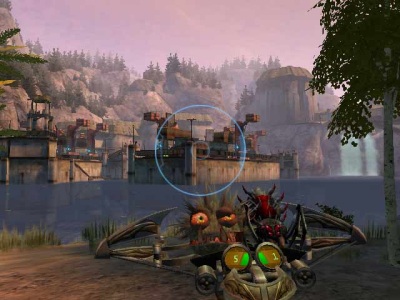
Oddworld has always been… well, odd. The previous three games in the series had been platformers, while Stranger’s Wrath decided to dip its toes in the waters of shooters. While it’s accurate to say that Stranger’s is indeed an fps, it’s decidedly not a mindless Call of Duty carnival sideshow where you just whack the baddies. Stranger’s Wrath is very artistic in its mayhem, where the settings are as alien as a town filled with talking chickens and your ammo is literally live animals. Stranger’s Wrath also features a pretty cool main character (The Stranger), whose past is shrouded in mystery.    

8. Sonic CD (Sega CD)

The defining game on the criminally underrated Sega CD. Sonic CD is quite unlike its Genesis counterparts. In addition to a funky CD soundtrack and some cool “Mode 7” style 3d graphics, Sonic CD features levels that actually encourage you to explore. While you still play as Sonic, and still run as fast as you can to the goalpost, the game no longer tries to force you along. There are three time zones that will have you going to the past, present, and future. In each of these time zones, the levels are different, and you’ll want to explore each era to see how the levels change. Sonic CD does lose a few points for introducing Sonic’s annoying love interest, Amy, to the series.

7. Star Trek 25th Anniversary (Computer)

Star Trek: 25th Anniversary is a trekkie’s dream come true. You’ll find yourself shooting photon torpedoes at Klingons in hair-raising space dogfights, to going on away missions to solve various mysteries. The game is broken up into seven different “episodes” and is actually described as a lost season of the tv show. The cherry on top of the sundae is that the entire original cast does extensive voiceover work. 25th Anniversary was created to honor Gene Roddenberry who had passed just a year before the game was made, and it’s a fitting tribute. The adventuring spirit of Star Trek is captured here, and at the end of the game, William Shatner gives a short but heartfelt speech honoring his friend.

6. Snow Bros. (NES)

Here’s a forgotten gem. Imagine Bubble Bobble but only better… and with snow. Well, that’s Snow Bros. in a nutshell. Your goal is to roll up monsters in big snowballs, then launch them away so they crash. It’s simply superior to Bubble Bobble because of the combo system. You see, you can time your snowballs so that they hit multiple enemies; this makes the game more interesting. Snow Bros. is also a blast with two players. I remember playing this game in elementary school with my best friend and how we could never get past the twin eagle boss. 

5. Sengoku 3 (Neo Geo)

SNK sure knew how to make arcade hits. Sadly, the Sengoku series never hit the mainstream like Samurai Shodown, Metal Slug, and other Neo Geo favorites. Honestly though, until this third installment, Sengoku was merely average. With the third iteration, however, it became something special. Unlike many beat-em-ups where you just mindlessly punch, kick, and repeat, Sengoku 3 allows you to combo your moves. It’s not Marvel vs. Capcom or anything, but it’s a nice touch and makes you feel like one badass ninja. The spritework of the game deserves praise as well. It’s like they took Garou: Mark of the Wolves, and just made the screen explode with action. It should also be noted that one of the main characters looks like Strider Hiryu, which is awesome.

4. MUSHA (Genesis)

I don’t much like spaceship shooters, but MUSHA is an exception. Considering this game was released in 1990, a full year before the Super Nintendo, I’d say it’s quite an accomplishment. The graphics are gorgeous for their time, and there’s some great use of parallax scrolling and illusory depth. I also love the game’s futuristic take on feudalistic Japanese architecture. While many shooters share a similar concept with MUSHA, it’s the smooth as butter controls that make it stand out. You can dodge enemy fire with the agility of a tiger… with lasers. There’s also a lot of customization for a game like this. You can choose one of three energy weapons to power up, as well as collect “P-chips” to surround your ship with helper robots. MUSHA also has some rockin music that goes above and beyond traditional Genesis fart sounds.

3. Body Harvest (N64)

Yes, the graphics in this game look like mud. Yet Body Harvest is one of the most ambitious games ever produced, and it paved the way for the Grand Theft Auto series. In Body Harvest your goal is to time travel to different places on Earth, and stop an alien invasion from ever taking place. So, you just kill aliens, right? Yes and no. You do, but you traverse the landscape anyway you want in order to do it. Not many N64 games have you blowing up stuff in a tank, to then hopping out and exploring the wreckage on foot. Body Harvest also has some light adventure aspects, as it allows you to enter buildings and talk to folks.

2. Ristar (Genesis)

It’s hard to believe that a game made by Sega in their heyday is not more well-known. Unlike most Sega games, Ristar doesn’t have a lot of attitude. In fact, he’s more like Mario than Sonic. The game consists of the titular Ristar using his stretchy arms to explore new areas and grabbing bad guys to give em a quick headbutt. Ristar really is a delightful game. You’ll explore new planets, each one completely different. These consist of a world covered in ice (if you stay still, Ristar will make a snowman), to one built entirely around musical instruments. As a quick mention to the graphics, Sega did the impossible: Ristar seemingly breaks the console’s 64 color limit. Now where's Ristar 2?

1. Shin Megami Tensei II (SNES)

Now we’re really getting obscure. Only released in Japan, but now available through English rom translations, Shin Megami Tensei II is the most controversial game I’ve ever played. The majority of the gameplay is similar to the old Wizardry DOS games in that it features a first person perspective in dungeons. Suffice to say, there’s not much to see in this mode, and it’s definitely not why I like this game. It’s the story. The plot of the game basically depicts you, Aleph, trying to kill God. Picking a fight with God might sound like a bad idea, but in this game, he’s evil as hell. I love the game for having the courage to show that not all interpretations of God are equal. Some are disgusting. SMT 2 could be shown as a critique of fundamentalism and hard-line Calvinism in particular. Good thing I believe in a loving God. 

Tuesday, June 25, 2013

Does God poison everything?


What’s moral? That’s a question that philosophers have pondered over for centuries, going back to the days of Plato. Good thing we don’t need philosophers anymore, according to Stephen Hawking (I guess he’s smart enough to solve every ethical dilemma by scribbling out a formula). Joking aside, morality is a question of what constitutes good and evil, the basis of society. Historically, for western civilization at least, our morality has been Christian. No one seriously disputes that, and even atheist philosophers like Nietzsche admit this only to say how rotten it is to be so, and how a Ubermensch “master morality” is to be preferred over a Christian “slave morality.”

Yet, the “new atheists” seem to naively believe that people just “know” what the right thing is, and that thousands of years on the quest for God have been a waste of time. The problem, of course, is that even “common sense” moral issues like feeding and clothing the poor is not an inherently good act. In fact, Ayn Rand, the devoutly atheistic apostle of Objectivism, coined the term “the virtue of selfishness.” Why help others? Why not just help yourself? God’s dead, right?

The late Christopher Hitchens subtitled his New York Times bestseller, God Is Not Great, with the words “how religion poisons everything.” I know it might sound corny, but I really do believe that Christianity is a relationship and not a religion. That being said, I’ll accept the label of religion for the sake of argument. Still, with a book so bold, you’d expect that atheism has a great track record with morality. Too bad that isn’t the case.

Maybe you could’ve been like H.G. Wells at the turn of the 20th century and hoped for a utopia based on secular ideals. After two world wars and a holocaust, however, I don’t think anyone can take this seriously. Especially when nations like the old Soviet Union actually attempted a godless utopia and failed miserably. Communism, as formulated by Karl Marx, is a wonderful idea in theory. It’s just completely ignorant of human nature. Every murdering communist despot, from Stalin to Mao and Pol Pot, has been an atheist. That’s a fact. It’s ironic that the proudly identified “militant atheists” of today once shared their name with the state backed League of Militant Atheists of the Soviet Union.

Then you have statistics. Ah yes, numbers never lie. According to Harvard University, which is hardly a bastion of Christian thinking, “forty percent of worship attending Americans volunteer regularly to help the poor and elderly, compared with 15% of Americans who never attend services.” Then you have the non-partisan organization, Statistics Canada, release data showing that “the average annual donation from a churchgoer is $1,038. For the rest of the population, $295.” Doesn’t look too good for the atheist utopia, huh?

So maybe religion isn’t so bad. Maybe the crusade against people of faith is misplaced. Maybe God doesn’t poison everything.

Tuesday, June 11, 2013

Star Trek Into Darkness


As a warning, this review contains spoilers. I usually don’t preface posts like that, but seeing how this is a new film, I’ll make an exception. So, Star Trek Into Darkness is basically a remake of Wrath of Khan… but I think we all saw this coming. It does seem that every time the Star Trek franchise wants a big hit, they turn to Khan. They did it in the Next Generation with Nemesis, with Data basically pulling a Spock and nobly sacrificing himself.

I’ve noticed a strange criticism of the movie made by trekkies: that since Into Darkness is primarily an action film, it is fundamentally not Star Trek. They say that the philosophical and exploration aspects of the series are hardly touched on. Well, they’re somewhat correct. If you’re talking about the tv show, then yeah, it doesn’t really adhere to that model. Yet, if you’re talking about the original film series, then you’re wrong. The most critically acclaimed and loved Star Trek movie was Wrath of Khan… which was predominantly an action movie compared to the previously released Motion Picture (that was almost universally hated).

With all that being said, this is the best Star Trek’s been in years. Khan’s in here (brilliantly and chillingly played by Benedict Cumberbatch), the Klingons make an appearance, and most importantly, Kirk and Spock are back. What’s not to like? The film is also intense as well, with dozens of thrilling sequences where the Enterprise looks like it’s going 20,000 leagues under the sea (actually that does happen once), and all hands are going to be lost. By the way, I love how they bring in Khan. The trailers made us certain that it couldn’t be him due to him wearing a Federation uniform; his introduction literally sent chills down my spine.

I guess what needs to talked about is the reversal of Kirk and Spock’s roles. It works wonderfully. Kirk sacrificing himself instead of Spock was such a twist, and I got a little misty eyed watching it. The scene also seems a little less hokey than in Wrath of Khan. When Kirk is kicking the generator back in place, you really feel the weight of his selfless decision. Spock’s reaction to his friend’s death also had me doing an “oh shit” face in the theater.

J.J. Abrams has done a fantastic job at bringing Star Trek to the masses while still maintaining the cast’s lovable personalities. Is there a lot of technobabble and pondering of the meaning of it all here? Not really, but at least Kirk isn’t asking God what he wants with a starship.